On this page
- What is a thought leadership strategy?
- What top thought leaders do
- How platforms reward authority
- 8 steps to build your strategy
- 01Own one expensive problem
- 02Write a positioning headline
- 03Choose weighted pillars
- 04Use one signature format
- 05Write hooks that make a claim
- 06Back every claim with proof
- 07Build a content system
- 08Engage and convert
- Short-form video
- How to measure it
- Your 90-day plan
- FAQ
- Final takeaway
Your expertise can be ten years deep and still invisible to the people who need it most. Buyers rarely hire the smartest person in the room. They hire the name they remember when the problem shows up.
To build authority around your expertise, own one expensive problem for one specific audience. Align your profiles with it, publish on three or four content pillars in a recognizable format, back every claim with proof, and stay consistent for at least 90 days.
In this guide, I’ll break down how top experts do it, backed by 2026 platform data.
What Is a Thought Leadership Strategy?
A thought leadership strategy is a plan for becoming the go-to name for one specific problem. It defines who you serve, which topics you own, how you prove your claims, and how often you show up.
It’s easy to confuse it with two related ideas:
| Concept | What it builds | Success looks like |
|---|---|---|
| Influence | Reach and attention | A large audience and high impressions |
| Personal branding | Recognition and reputation | People know who you are and what you do |
| Thought leadership | Authority on one problem | People cite, recommend, and hire you for it |
Influence gets you seen. Personal branding gets you recognized. Thought leadership gets you trusted with the problem.
What Top Thought Leaders Do Differently
The most trusted experts don’t all win on the same platform, but they follow the same playbook.
| Creator | Known for | Strongest platform | Signature approach |
|---|---|---|---|
| Rob Dance | Trust-based leadership | Black-and-yellow quote image with a long caption | |
| Dan Go | Health for busy founders | Instagram, LinkedIn, and X | Single image, client case studies, health data |
| Justin Welsh | One-person business | LinkedIn and X | Tweet-style screenshot with a longer caption |
| Ruben Hassid | Teaching people to use AI | Single image with numbered steps | |
| Allie K. Miller | AI strategy for leaders | Practical AI breakdowns on her own frameworks | |
| Dan Koe | Focus and one-person business | YouTube, X, and Instagram | Weekly essay repurposed into videos and posts |
Four patterns repeat across all of them:
- Narrow position: Each one owns a single problem for a specific audience, such as fitness for busy founders or AI strategy for executives.
- One repeated belief: The top UK LinkedIn creator by median likes repeats one idea, that trust beats control, in nearly every post.
- A recognizable format: Quote cards, tweet-style screenshots, or numbered-step images make posts identifiable before anyone reads the name.
- An owned channel: Their newsletter is the hub, and social platforms feed it. One writer turns each weekly newsletter into YouTube videos and short posts.
Follower count isn’t one of the patterns. In MagicPost’s 2026 LinkedIn thought leadership ranking, a creator with 5,000 followers placed seventh, while Gary Vaynerchuk, with 6.1 million, landed 21st.
How Platforms Reward Authority in 2026
Every major platform now ranks content with AI that rewards topical depth over popularity. As LinkedIn rebuilt its feed around LLM-based ranking, Richard van der Blom’s analysis of 1.8 million posts found views fell about 50% and follower growth slowed 59% in a year.
Here’s what that means for you:
- Align your profile and content: Your headline and About section tell LinkedIn what you’re credible on.
- Stay on 2 to 3 topics for 60 to 90 days: That’s how long practitioners report it takes to build a trusted topic profile.
- Earn depth signals: Saves, replies, and time spent outweigh likes on every platform.
- Favor visual formats on LinkedIn: Socialinsider’s Q3 2026 benchmarks put PDF carousels and multi-image posts at 6.4% engagement, versus 3.5% for text-only posts and 2.5% for link posts.
8 Steps to Build a Thought Leadership Strategy
Each step below comes from what proven thought leaders already do every week.
01Own One Expensive Problem
Pick the problem you want your name tied to before you write a single post. Test it three ways:
- Audience: Enough people actively care about it.
- Business: Solving it publicly leads to your paid offer.
- Enjoyment: You can talk about it for years.
If it fails one test, narrow it further.
02Write a Positioning Headline
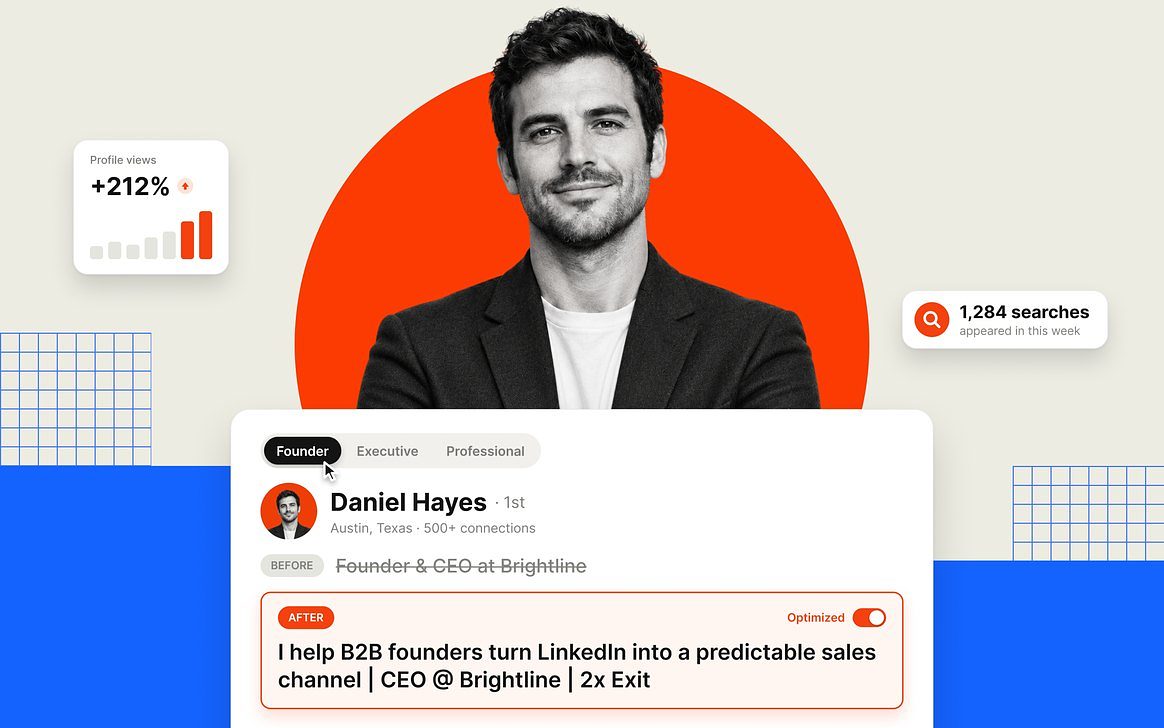
Your headline should answer five buyer questions: the outcome, the audience, the objection removed, your role, and the next step. Dan Go’s LinkedIn headline does all five: “I help entrepreneurs get lean, focused, and high-performing without sacrificing their business. Body Transformation Coach to Entrepreneurs. Apply below.”
Then make your banner, About section, and featured links carry the same message, and reuse it in every platform bio.
03Choose 3 to 4 Weighted Content Pillars
Pillars are the topics your audience should link to your name. How you execute each one matters as much as the topic. An audit of about 100 LinkedIn posts from Dan Go shows the gap:
Systems beat quick tips, high-stakes stories beat small wins, and perspective shifts beat generic advice. Tie each pillar to something your buyer values, such as revenue, status, or time.
04Use One Signature Format
Pick one visual template in your brand colors and use it for most posts for at least three months. It builds recognition and cuts production time. Ruben Hassid used single images with numbered steps in about 79% of his LinkedIn posts over 13 weeks.
05Write Hooks That Make a Claim
Your first line decides whether anyone reads on, and ranking systems use it to understand your topic. Make a claim instead of describing the topic.
Here’s how a full post builds on its hook, from the claim to the call to action:
Skip hooks that lead with “Comment X to get” and posts that only repeat industry news.
06Back Every Claim With Proof
Opinions earn likes. Proof earns clients. Use:
- Client results: Measurable outcomes from your work.
- Your own numbers: Revenue, conversion rates, or time saved.
- Documented processes: Frameworks and screenshots of how you work.
- Public recognition: Media features, awards, and speaking invitations.
07Build a Content System You Can Sustain
Test ideas in short posts, expand the winners into carousels and case studies, and turn the best into a weekly newsletter or video. Start with this weekly plan:
| Day | Content | Format | Goal |
|---|---|---|---|
| Monday | Contrarian industry take | Short video | Spark discussion |
| Tuesday | Step-by-step playbook | PDF carousel or thread | Earn saves |
| Wednesday | Client result | Signature image | Prove expertise |
| Thursday | Quick how-to tip | Short video | Build reach |
| Friday | Core belief or lesson | Signature quote image | Sharpen your point of view |
| Weekly | Newsletter issue | Own your audience |
Five posts a week on one platform is enough. Repurpose for a second platform instead of writing everything twice.
08Engage and Convert
Attention without a conversion path is borrowed visibility. Ruben Hassid has about 854,000 LinkedIn followers, yet one audit scored his profile 10 out of 100 for conversion because it had no About section and no booking link.
- Engage daily: Spend 20 to 30 minutes replying and commenting where your buyers already are.
- Offer a low-friction step: Put your newsletter or free guide in your banner, bio, and pinned post.
- Offer a high-intent step: Make your call or service page easy to find.
- Use soft CTAs: End most posts with one relevant next step, not a pitch.
How to Use Short-Form Video
Video shows your thinking in a way text can’t. Upload vertical clips natively, keep them to 30 to 90 seconds, and add burned-in captions.
- 0 to 3 seconds: Say the hook and show it on screen.
- 3 to 15 seconds: State your main point.
- 15 to 45 seconds: Give two or three steps, or one example with a real number.
- 45 to 60 seconds: End with one takeaway.
How to Measure Thought Leadership
Track the quality of attention, not the quantity. Review these every week:
| Metric | What progress looks like |
|---|---|
| Replies from ideal buyers | More decision-makers in your comments |
| Saves and shares | Highest on playbooks and carousels |
| Reach outside your network | Steady growth after week 6 to 8 |
| Newsletter sign-ups | Consistent weekly growth |
| Inbound conversations | Qualified DMs, referrals, and booked calls |
Once a month, compare median results by pillar and hook. One viral post can mislead you. Medians won’t.
Your 90-Day Thought Leadership Plan
- Days 1 to 30, Foundation: Pick your problem, rewrite your headline and bios, choose your pillars, and post 3 to 5 times a week.
- Days 31 to 60, Consistency: Post 5 times a week, launch your newsletter, and engage daily.
- Days 61 to 90, Proof: Add case studies and video, repurpose to a second platform, and use soft CTAs.
Move to the next phase only when you pass its gate. If you haven’t, improve quality instead of adding volume.
Frequently Asked Questions
Which platform is best for thought leadership?
The one your buyers already use. LinkedIn suits B2B experts, X suits tech and startups, and YouTube suits topics that need depth. Pair any of them with a newsletter.
How long does it take to become a thought leader?
Expect 60 to 90 days before platforms treat you as credible on a topic, and longer before buyers do.
Do you need a large following?
No. Ranking systems now distribute content by topic relevance and engagement depth, not follower count.
Can you use AI to create thought leadership content?
Use AI to organize and edit your ideas, not to supply them. Platforms deprioritize generic AI content, and readers notice.
Final Takeaway
Thought leadership isn’t about posting more. It’s about owning one problem so clearly that people think of you first when it comes up.
Narrow your position, prove every claim, and stay consistent for 90 days. Your reputation will keep compounding long after each post disappears.